Monday, September 28, 2009

Ars Electronica - more links


ArsElectronica - more of the prize categories and winners:

- interactive art: The EyeWriter - a low-cost eye-tracking apparatus by Zach Lieberman (US), James Powderly (US), Tony Quan (US), Evan Roth, (US), Chris Sugrue (US) and Theo Watson (UK)

- hybrid art: Ear on Arm - a modification of body architecture. (not for the faint-hearted) by Stelarc (AU)

- digital communities: Chaos Computer Club - the largest european community of computer hackers

- [the next idea]: Hostage - a nano installation (more) by Frederik De Wilde (BE)

-- back to main post

Friday, September 18, 2009

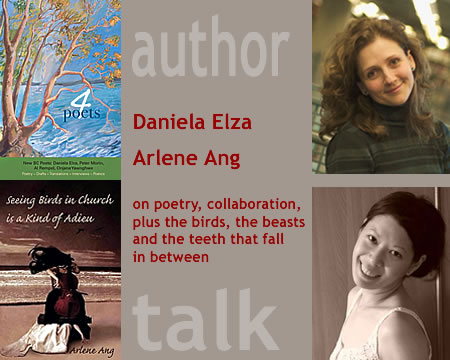
author talk: Daniela Elza + Arlene Ang


ABOUT THE AUTHORS + THE TALK

Daniela Elza is a free-range poet, and a non-medicated scholar of the poetic consciousness. She has rel.eased more than a 140 organic poems into the wor(l)d in over 42 publications. Her inte.rests lie in the gaps, rubs, and b.ridges between poetry, language, and philosophy. She is currently compiling her second manuscript and collaborating with fellow poets. Daniela is the recipient of this year's Pandora's Collective Citizenship Award. She lives with her family in Vancouver and spo.radically blogs at Strange Places.

Arlene Ang is the author of The Desecration of Doves (2005), Secret Love Poems (Rubicon Press, 2007), and a collaborative book with Valerie Fox, Bundles of Letters Including A, V and Epsilon (Texture Press, 2008). Her third full-length collection, Seeing Birds in Church is a Kind of Adieu was published by Cinnamon Press in 2010. Her poems have appeared in Ambit, Caketrain, Diagram, Poetry Ireland, Poet Lore, Rattle, Salt Hill as well as the Best of the Web anthologies 2008 and 2009 (Dzanc Books). She lives in Spinea, Italy where she serves as staff editor for The Pedestal Magazine and Press 1. Website: arlene ang, Blog: event museum

This author talk took place in the virtual daily café in September.


Arlene: To begin at the beginning, how did you get started with poetry? How did this influence your writing?

Daniela: I have written poems for as long as I can remember. In the beginning, mostly for fun, for friends and family, for different occasions. Recently, my parents read me over the phone a poem I wrote for their anniversary. I was touched. They have kept it for close to three decades. There was something very rewarding and magical to express in words (words available to every one), something that touches another. Something I could give as a gift. It is empowering, especially for a child, this kind of giving. To create something real with your words. I am still under that spell. After two Masters degrees and an almost PhD I have not changed my mind about the power and magic of poetic language.

And for you, Arlene? Why poetry?


Arlene: What fascinates me about poetry is how it involves the reader and allows different interpretations depending on who's reading it. It's like Da Vinci's Mona Lisa and people would stand there saying: "That's a man. Trust me." "Don't like her. Bet she poisoned puppies and children." "Look at her hands. That's chronic arthritis for you." I find it quite fascinating. Fiction, on the other hand, requires less creativity on the reader's part. I also like to think that poetry has a higher alcohol content than prose since it's a distillation of experience or thought. It's no incident that alcohol travels faster in the blood stream and gives a nice rush to the system.

Daniela: Freedom in interpretation that poetry offers is important. Perhaps the kind of freedom that one experiences in reverie. Isn’t that how we come to own a poem? Although we do not tend to teach it this way. There is a tendency to put a straitjacket on it. Interesting you liken it to alcohol. Robert Bringhurst (2007) says: "Poetry, like alcohol and sex, is subject to rules and invested with ritual because of the threat it represents."

Arlene, this year I compiled my first full-length manuscript and am now working on putting together the next one. I feel like a beginner again. How did you go about putting together the manuscript of your latest book: Seeing Birds in Church is a Kind of Adieu?


Arlene: Seeing Birds started out in 2005 as The Lean Season, which came out of my obsession with dying and illness. At the time, my father just passed away from cancer and most of the poems were written during his last months. It bounced around from one rejection to another—once with a ticklish comment attached that it was too depressing and the publisher didn't want to bring down the morale of their readers—until 2008 when Envoi editor, Jan Fortune-Wood mentioned that she might be interested in a poetry manuscript. I was, by then, a regular contributor to the print journal as well as their anthologies, published under Cinnamon Press. Incidentally, I had The Lean Season manuscript lying around, forgotten and lonely in some folder. My mother had just passed away from cancer, two years after my dad did, and rather than obsessing about death, I was more concerned about letting go this time. With both of my parents gone, it felt important—like losing the two pillars that held you up, it was either you learned to let go and stand on your own feet or get buried under the rubble.

Originally, I had the manuscript divided into four sections—one in particular contained the sonnets and sonnenizios. The publisher suggested removing them because she thought the poems flowed well into each other.

One thing I did insist upon was using Oana Cambrea's gorgeous artwork for the cover. I'm a huge fan of her work and have also used her art for my website and a chapbook, Secret Love Poems (Rubicon Press, 2007).


Daniela: Curious comment you got from that publisher. I am not much into stuff that is dark and depressing and I believe that if an author chooses to write about that they have to work at redeeming the reader. Otherwise, what would be the difference between that and the 6 o'clock news?

When I started reading your book I knew it was going to be one of those books you savour. I did not want to read too fast, in fear of getting to the end. After I read it I caught myself reading the poems to friends, over the phone, or over a cup of something. There are not many poetry books I do that with. Like a part of me knew I was learning something important. I keep going back to different poems I have folded the pages on. It is brave, full of heart, wonderfully surreal, not at all sentimental. For sure, a loosening of the grip. Some lines that stuck with me:

in the poem "A Study of Loss" (p. 42) you say:


_____Death itself is a growing out
_____of one's body—

and later:

_____If you listen carefully,
_____you will hear how the house
_____creaks from the burden
_____of holding itself together.

and "Col San Martino" (p.17) ends with:

_____The journey is over. You empty
_____your pockets on the front seat: old coins,
_____a bracelet, fridge notes, his birthstone.
_____There is no burden like unwanted things.


Arlene: “A Study of Loss” originally had an epigram from Anne Carson’s Autobiography of Red—one of my favorite poetry books ever.

_________How do you think it feels
growing up in a house full
of empty fruit bowls?


It struck me on a personal level because ever since my father, who was passionate about bananas, died, all the fruit bowls in the house just stood there empty. The poem eventually evolved outside that context and the quote felt out of place so I removed it.

“Col San Martino” is a very old poem, from more than five years ago. Even though it’s about a marriage ending and coming to terms with it, it’s also about letting go. I’ve often wondered if life itself is a lesson on letting go. We hoard so many things and try to hold on these—memories, material goods, loved ones, our physical bodies—but in the end we ourselves have to slip away from them.


(click to enlarge)

Daniela: Yes, how to let go? Here, in North America materialism is so rampant. A plague, really. And the disposability that supports such a system also robs things of acquiring spiritual meaning. I see freedom in poetry because we all own the materials it is made of, and it provides a spiritual self sufficiency which materialism does not like, since it wants you to be dependent on it. I think when we are emotionally in tact we need less stuff.

But back to loss. You write about loss in a away that is not dumping it on the reader, saying: here you figure out what to do with it. You own it. And the poems rise above it. They move into the realm of the metaphysical addressing questions of existence "We don't know exactly why we are here" (“Fishbowl”, p.8). The grief seeps through the images. It is tender, this grief. The way you offer the poems allows for me to enter, orient myself, find my own emotional compass. In “Refraction” you say:


_____I have death hiked up to my waist.
_____It is afternoon as the rest
_____of a woman's life can be an afternoon.

and later on in the poem:

_____Between the body he is,
_____and the body he isn't, there is a refraction
_____of light. An afternoon, raised
_____like an arm reaching up for an apple.

I like the way you manage to slow time down to a canvas. The way you use art in the poems reinforces that. Paintings on the walls, looking into mirrors, your dad painting his 111th crucifix. Like still life canvases:-), in which we are still in the face of what we are confronted with or perhaps confounded by. This kind of stillness allows for a meditative space where enlightenment, epiphany (call it what you will), this coming to understanding, to acceptance, is possible.
And humour. I appreciate your humour. I love:

_____The doilies are punishing
_____the sideboard with floral designs. (Fishbowl, p.8)


But, really, just pulling quotes out is not doing it justice. The taste is in the whole. The complexity of it. In the threads it teases and pulls out of the fabric of human frailty and existence.


Arlene: Thanks, Daniela. I was just thinking about your poem, "interpreting the winds" (4 poets by Mother Tongue Publishing, 2009) and how it seemed to stop time because of the flurry of activity happening between the lines:

____________today_____ they are lovers ________peacefully sleeping

________yesterday____ they were legends: ______feuding brothers

_____and sisters _____who turned to rivers_____ forever

__flowing away_____ from each other.


I think it’s very clever how you managed to make the words/phrases work horizontally and vertically. My favourite is "they are lovers / they were legends: / who turned to rivers / from each other."
This illustrates so well the nature of winds as they carry the weight of many dust particles, even insects.

Also, "in the flicker of (time," there's a sense of life as it is captured:

_____this river ________is not time.
_____in the shutter of __ _your eye
________it is __________a l w a y s.

I do love how these lines evoke the spirit of photographs and how places/moments seem to stop in those. I notice that you use the river image in both poems. Do they have a personal meaning or symbolism to you?

Daniela: I am happy you found these alternate readings. One of the things I like to encourage with my form is such readings. Where you allow yourself to make your own poem. So thanks for doing that.

Interesting, about the river. I do think better around water. Water is life. And the river is the same, and always moving and different. Just like us. (And curious that both the cover images of our current books have bodies of water in them).


I realise that water is quite present in my work and part of my quest is to find out why. Reflections in lakes and puddles invite me to reflect. Maybe my next manuscript will help me puzzle some of it out.

Arlene: How about your current manuscript? What made you decide it was time? Would you like to talk about the process of how you put it together?

Daniela: My manuscript is looking for a home right now. What compelled me to gather the poems is to gain insight into why the crows are such a persistent image? Over the course of a decade I had amassed quite a number of these poems. I put them together. Read them, moved them around, re-read them, until it felt right. There are a few sections in it. It keeps changing. They do not want to sit still, these crows. What I discovered was that the whole begins to take on a life of its own and to reveal patterns that none of the individual poems could by themselves. So there were discoveries along the way.

Did you find something new once you gathered the poems in Seeing Birds...? Were there any surprises?

Arlene: Surprises, no. My poems are more static than yours, I think, less open to different shades of meaning. I’m moved to capture the moment instead of letting the moment slide into view. It’s one of the reasons I’m terrible at writing haiku.


I've been enjoying the anthology, 4 poets (Mother Tongue Publishing, 2009) where you have 9 poems (26 pages) published. Did you reply to a call for submissions or were you invited? I noticed that Al Rempel—with whom you have a collaborative poem in the recent issue of Pedestal Magazine ("unhinged")—also has poems in the anthology.


(click to enlarge)

Are you connected in other ways to the other poets, too?

Daniela: There was a call for submissions for 4 poets. Al and I were introduced to each other in the Rocksalt Anthology (Mother Tongue Publishing, 2008) and met in 4 poets. The same for the other poets in the book, which brings together four emerging BC poets. It also has an interview with each poet, a bio, a poetics, a photo, and one of the poems comes with three previous drafts, and a translation. I translated my poem into Bulgarian. It is a made in BC book: artists, publisher, editor/s, poets. Talking about journeys, I realise the poems there are all about the journeys we are on. What we find in the process.
Incidentally, both Al and I had excerpts selected from poems in 4 poets to be part of the
Poetry in Transit for 2010 which puts poetry on the transit system.

Al was one of the poets who accepted the invitation to write together. Not everyone is into that kind of stuff. Sometimes people give it a try, and are done. And sometimes we go on to write more poems. Like you and I (starting our 5th poem soon).


Arlene: How many languages do you speak, by the way? Do you find it easy to write poetry in Bulgarian and other languages? Even though my native tongue is Filipino and I can converse in Italian, I find that my command of both languages isn't sufficient when it comes to writing poetry.

Daniela: English is the language I write in. I went to school in English. I cannot compose poems in Bulgarian. I mostly spoke Bulgarian at home. The translation, however, was a different experience. That process brought me to a new appreciation for my mother tongue.

Arlene, Just the other day, I was sitting on my patio reading to a friend of mine, Christi, from your book. Well, really taking turns reading. It was interesting to note the recurrence of the image of the fish. The fish, also a symbol for Christ.


Arlene: I never made the Christ connection before, but my dad collected fish figurines—a symbol of prosperity for the Chinese—and also used the image a lot in his paintings (like the example above). Back in Manila, I was constantly surrounded by people who had ponds or aquariums. I used to have suicidal goldfish, too. Which makes me wonder... what about your affinity for crows?

Daniela: Me and the crows go way back: I gave them my milk teeth. That was the custom in Bulgaria: you chant a little chant and toss your tooth on the roof asking the crow to give you a strong new tooth. I have tried to capture this experience in the poem “Milk Tooth Bane Bone.” A title which I adopted as a working title for my crow manuscript.

Arlene: The idea of giving your teeth to the crows is fascinating. When you wrote:

_____I gave my teeth to the crows
_____and they have not left me alone.

I thought it was only metaphorically. I do love the idea of the crows refusing to leave you alone—as if it was a kind of Faustian soul contract. Incidentally, I just saw Terry Pratchett’s Hogfather and the villain there kidnapped the tooth fairy based on the theory that who has your milk teeth has power over your beliefs and dreams. It's fun to think of the possibilities of crows being in the teeth business instead.

Daniela: That is a delightful observation. It is a big topic—images. The images we are fed with, the relationship we form to them, may be playing important roles in our formation as beings. We all have such images. The "transaction" with the crows connects me with the world of the wild, to otherness, and one that is so close to us. Reminds me of my own wildness. Bringhurst says: we are grown out of this world like mushrooms and buttercups.

Arlene: Would you say the same for poems? That they grow a life of their own?

Daniela: Incidentally, just the other day I was reading Dorothea Lasky’s little book called “Poetry Is Not a Project” in which she says:

“I think poems come from the earth and work through the mind from the ground up. I think that poems are living things that grow from the earth into the brain rather than things that are planted within the earth by the brain.”
(Ugly Duckling Presse, 2010).

No matter how we think of our poems, they have a life of their own. We are exchanging ideas about each other’s work. These layers are like gifts. Each time the poem is read it has the potential to capture something anew. Even for the one who wrote it. The writer too changes.The poem comes to life between the page, the dreamer and his reverie. Once it is out in the world, the poet has little control over it. Like our children, we give them life, we do the best we can for them, and then they go out into the world and become their own beings. They surprise us in different ways. Some developments you can link directly back to something you laid the seeds for. But some things will surprise you. The fact that someone was touched this way, or came up with a connection, cannot be overlooked. It is as real as your poem is. That is their experience of it.


Arlene: That is so true! I usually write my first drafts in ITWS, an online forum where there’s this challenge to write 30 poems for 30 days. The basic rule there is to comment on everyone’s poems—there would usually be three to five people doing the marathon together and it’s always interesting to read the immediate interpretation or reaction of others. It feels like Rashomon every time—one scene with everyone noticing and interpreting different things based on their experiences.

One of the things that I love about our collaborations is that it's like watching two realities merging—mine and yours.

Daniela: The experience is unique with each person. With some it is easier than others. At its best it is like a dance between two. I feel it has been that way for us. I am learning form our collaborations. I become more aware of my own processes, while I am also invited into yours. And I learn from both. We can even talk of intimacy here.

Arlene: Intimacy. Oh yes. And there's something rather wicked about doing "it" in PiratePad, too.


(click to enlarge)

Do you find that having this real-time editing/chat room helps you in terms of collaborating on a poem or is it the same for you via e-mail?


Daniela: Yes, PiratePad is great. Thanks for setting us up with it, for getting us our own room. :-) Much better than email. Or sending docs back and forth.

It saves time on the fidgety boring parts of copy, paste etc. Helps me focus more on the work.

I recently got my copy of Mutating the Signature (print version). It is lovely to see us again in there. We met in a book, Arlene. Ok, originally the issue went up on the qarrtsiluni website. But, now, I have the book. Alternatively, we met online at some dating service. :-) Titled Mutating the Signature. :-)


Arlene: That feels like ages ago. And here we are—four grown kids later, I mean, poems. It must be the “nature” in signature working its magic. Our eldest, “what fills our footsteps” has even found stable employment at Poemeleon. Feel free to check it out and say hi to junior for us - click to enter, then scroll down.


Daniela: Thank you Arlene, for joining me here at virtual cafe today. We are out of time, but let the talk continue in the comments below. No one is clocking the comment section.

Arlene: And Dorothee, thank you for the invitation, and for hosting us. The coffee was excellent.

Dorothee: Arlene, Daniela: Thanks for visiting the Daily Café, and for bringing your words and images, and your reflections. It was a joy to listen to you, and almost feels like this talk happened for real, at a wooden table filled with books and coffee cups.

[THE END]

further reading + browsing

author links:
- Website Arlene Ang
- blog Daniela Elza

books:
- Bringhurst, R. (2007). Everywhere being is dancing: Twenty pieces of thinking. Nova Scotia, Canada: Gaspereau Press.
- Carson, A. (1998). Autobiography of Red: A Novel in Verse. New York, NY: Knopf.

other author talks
- Jessie Carty and Mel Bosworth (poetry + fiction)
- Rose Hunter and Dorothee Lang (stories + journeys)

Thursday, August 20, 2009

author talk: Jessie Carty & Mel Bosworth


ABOUT THE AUTHORS + THE TALK
Jessie Carty is the author of the full length poetry collection Paper House (Folded Word, 2010) and two chapbooks The Wait of Atom (Folded Word, 2009) and At the A & P Meridiem (Pudding House, 2009). She is often beset by cats from her home in North Carolina where she continues to write, edit and teach. Recent online publications: Scythe, Drunken Boat, Girls with Insurance and others: link list.

Mel Bosworth is the author Freight (Folded Word, 2011), Grease Stains, Kismet, and Maternal Wisdom (Aqueous Books, 2010), and When the Cats Razzed the Chickens (Folded Word, 2009). He lives, breathes, and laughs in western Massachusetts. Recent online publications: Necessary Fiction, The Northville Review, Dark Sky Magazine and others: link list.

This author talk took place in the virtual daily café in August.


Jessie: You have quite a prolific publication schedule recently! I'm saying this to you as I've heard the same thing. I wonder if your experience was similar to mine in that you sent stuff out for years and then all of a sudden things just started to fall into place. I'd like to hear a bit about your recent books (or other notable publications in journals) and how they came to finally show up on the screen or the page?

Mel: Yeah, Jessie, things have been busy lately, for the both of us. I've got a book coming out and your poetry collection Paper House just dropped in March of this year. And hey- it just occurred to me that this conversation is between a poet and a fiction writer, for the most part. That's kind of cool. But anyway, yes, my novella Grease Stains, Kismet, and Maternal Wisdom is slated to drop sometime in August. Aqueous Books has been very good to me. I'm excited to hold a copy in my hands. And to backtrack a bit to an earlier question, I'd have to say that things really started to pick up for me (publishing-wise) when I stopped being such a scaredy-cat of the internet.

Jessie: I am amazed that you were scared of the internet! I see you publishing online, blogging and even vlogging with the best of them! When I came back to writing after not submitting, or writing much of anything from 2001-2005, I was amazed at what a powerhouse the internet had become. It really does make researching where to send you work and the actual sending of work much easier. I even chose which publishers to submit my chapbook manuscripts to based on internet groups like CRWOPPS (link).

Mel: I was sending out work in hard copy form for a few years with no luck, but once that crazy internet got into my brain- boom. Whole new world. And now I shall backtrack yet again to the idea of holding a copy of your own book in your very own hands. Hot damn. What was that like, Jessie, when you received your first copy of Paper House? We've both had the experience of holding our own chapbooks, but what was it like to hold a true blue BOOK in your hands? And no disrespect to chapbooks, I love them and venerate them, but your standard paperback book is a different beast. What was that like? I'm looking forward to the sensation. Also, what were some of your personal favorites from the Paper House collection? Feel free to throw some quotes out there.


Jessie: I do love my chapbooks but I find it hard to describe what it was like to hold a perfect bound book in my hands which contained my poems, which had my name splashed across the front. Folded Word did such a beautiful job with the design. I was speechless! Every time I pull out a copy to read from or to sign, I find myself caressing the book like it is a pet. Oh how I love it! I can’t wait for you to have that experience. To see the book after so many years of trying to circulate the individual poems for publication while still revising and figuring out which ones go together was truly one of the best days of my life. It is hard for me to pick favorites from the book but there are poems I enjoy reading quite a lot. I’ll give you a full poem because it is short and is a nice transitional piece when I’m reading. It is a bit of a surprise, a twist on the whole idea of fairy tale:

Little Red

I let the wolf
hold me
felt his teeth
against my teeth
because he came
and I wanted
to give


Mel: I absolutely love “Little Red,” Jessie. The whole Paper House collection, in fact. And you’re so right—I can’t wait to have that experience of holding my very own book in my hands. But back to poetry, Paper House reminded me that the kind of poetry I enjoy reading the most is the kind that tells stories. Now, arguably, all forms of writing tell stories, but your collection, to me, blurs that line between fiction and poetry. Some call it “verse fiction” or “prose poetry.”

Jessie: I know you are primarily a fiction writer but you have done a lot to support poets as well with your YouTube site and reviews that you have written. I found quite a few of your short stories in your Folded Word collection When the Cats Razzed the Chickens that were very poetic. Are you influence at all by poetry? I’d love to hear some excerpts from your new book as well.

Mel: I’m definitely influenced by poetry. I’m also influenced by the sunshine. And rain. And weather in general. Breathing is a big inspiration. And I think it is fair to say that some of the work in my Folded Word collection (we’re Folded Family!) has a poetic tint to it. Because it’s hard not to blur the lines these days. I credit the internet with that too, and these accelerated times. It’s exciting to be a writer and to be alive, really, because things are evolving so rapidly, and to stay fresh one has to truly yield to that evolution. I think that’s kind of our job as writers, and as humans. We have to yield and absorb. Would you agree with that? And as far as my new book goes, I’ve been having a hard time finding fun quotes because so much of the work is just action and dialogue, but I’ll take a quick shot. The book, in essence, is a love story.

From Grease Stains, Kismet, and Maternal Wisdom:
“I was touching Samantha’s leg. She was touching my hand. We held hands. We were slow. Everything was okay. But the cowbell of reality still clanged around my neck, and Samantha’s too, only it was no longer in the form of her mother’s stern voice from the morning, but of something much more visceral, heavy, something now. It was in the car with us, it was in the music, it was in our hands as we touched, it was in the lights that we moved through, it was in the road, it was in the sun…The sun was in my eyes. I dropped the visor and sighed. I was getting heavy…and sad.”


Jessie: I love the excerpt you chose from Grease Stains.. (full title = awesome) because it flows exactly into what we were talking about: the conjunction of fiction and poetry. I’m around a lot of writers and many of the best prose writers will say they admire poetry but that they cannot write it, but when you read their writing you can point out to them just how poetic they actually are.

If I saw this except by itself, as an editor, I would fall in love with it as a prose poem because the action moves from word to word. You build tension by the power of vocabulary without having to focus on other “effects” of writing. You sentences sound more poetic than some of my poetry does! As you noted, I tend to want to tell stories in my poems. I definitely consider myself primarily a narrative poet and that is also the type of poetry I enjoy although I will never toss away a really awesome reflective haiku either (am I, like a teenage girl, saying awesome too much?) I also find breathing, by the way, as a big inspiration! Too funny.

Mel: You can never say “awesome” too much, Jessie. Never ever. And I’m glad that you revere haiku too! I think haiku get a bad rap sometimes. And you’re working on a series of prose poems? HMMMMM! Tell me more about this project.

Jessie: I tend to have at least one prose poem and one haiku in most of my projects but this group, so far, appears to be leaning towards being just prose poetry and like your excerpt the poem moves by the individual word rather than focusing on where the line ends.

The words of poetry and prose are much closer than maybe most people realize. Historically, they have feed off of each other as poetry came out of the oral traditions once writing was invented. Then the novel started emerging to re-tell these epic legends that were only previously presented in verse and now some of that is circling back as anyone with a computer can become more of a Renaissance man/woman than the Renaissance men could have been during their own time just given the width and breadth of knowledge that is available.

I love your quote that as writer’s we should “yield and absorb.” That is a terrific way to put this almost un-nameable thing we call a muse or inspiration. For those who aren’t writer’s, what writer’s do is take in the world and then try to distill it back for their reader’s in a way that is new. Speaking of readers, do you feel like you write for a specific audience?

Mel: I suppose I just try to create things that are readable. Things people might enjoy. Things I enjoy. I write my best, I think, when I’m having fun. The first task is to get the idea down on paper, then sew all of its moving parts together so it can live outside of my head. Lastly, with the awesome internet at our fingertips, and Duotrope.com in particular, it’s easy to locate an audience for most anything these days. So, to answer your question simply, I write for anyone and everyone, but for myself first. If the writing isn’t honest, it’s probably not going to be very good.

And if I can backtrack again for a moment, we’ve touched upon the internet and its many avenues and opportunities. The first time we connected was through the YouTube channel Shape of a Box, an online literary venture that you created. First of all, thank you for accepting my silly little piece "A Matter of Perspective" way back when, and secondly, what do you enjoy most about online literary magazines/projects? More specifically, tell me about Referential Magazine, your new brainchild.


Jessie: I loved working on “Shape of a Box” and was THRILLED when I published your piece even more so when I saw the hilarious drawings that would be put into the video. I was a bit jealous when Jessi (my former assistant editor at Shape and now managing editor of Folded Word Press) was the one to actually put the video together, but I needed more people like her because that project was so time consuming. I had to let it go but I couldn’t let go of the joy that is finding writers and artists for a publication so I started “Referential Magazine” so I could continue to do that. Being around other writers also keeps me grounded and inspires me. That is what I like about working on a literary magazine.

At “Referential” we started out with a few poems and then built from those pieces. By built I mean most new pieces that appear, whether prose, poetry or art, refer in some way to something else on the site. They can refer to the word “the” for all I care, but I like seeing that kind of virtual collaboration.


I have taken on new editors to help me with the work at “Referential” and I was worried that the voice of the project would change but I am amazed at how easily these new editors have fit in. We are looking for good writing and I’ve never seen a piece that we disagreed on and I’ve only actually ever met any of the editors in real life once yet somehow we have this same vision and voice for the project. I never intend to prepare “Referential” or any of my own writing really for a specific audience. I just write what I would like to read and I publish what I like to read but I’ve been hearing a lot of people talk about writing for an audience (and I’m prepping a writing composition class) and I wondered how cognizant most writers were of that issue when they were writing. Um, and why haven’t you submitted anything yet? Hmmmm.

Mel: You’re awesome, Jessie. And Referential is awesome too. Congrats a million times over on all of your projects. You are a writing machine! And I know I know! I haven’t submitted anything to Referential yet. I know I know. I will. I will. I promise. It’s just been a busy, somewhat scattered year for me this 2010. But in a good way. Changes in my “real” life have put a bit of a pinch on the writing time in my “fake” life. Ha. That doesn’t sound right. But I think you know what I mean. The balancing act is tricky.

And a thought just popped into my mind: how important is it to be greedy, from a writer’s standpoint? And I don’t mean “greedy” in a bad way. I mean “greedy” in a virtuous way (ha!). We’ve both had a taste of success in the indie publishing world, and it’s been a great taste, but what grabs me and often scares me the most after finishing a project, or even when I’m working on a current project, is the thought of, “Oh, crap! What am I going to write next?” Is it drive? Paranoia? A fundamental flaw that exists in all creative types? Is it a need to create or a need to be validated for that which we create or both? How does one balance, with any consistency, the confidence needed to focus while writing and the wild insecurity that often flings open the door to raw emotion? Confidence and vulnerability. How do you strike a balance, Jessie? Coffee? Something stronger? A loved one? A comfortable crying pillow? Where was I going with this train of thought?

Jessie: Oh, this greedy discussion is so in the front of my mind right now! I am writing a lot right not but I didn’t write anything from 2000-2005 so I find myself scared that I’ll lose my momentum and I won’t be able to write if I don’t keep doing as much writing as I possibly can. Whenever I go for a day without writing I get worried that I’m done for. That doesn’t mean everything I write is publishable but I like to try and put something down on paper or the computer screen each day just to show I can.
I love to finish a projects but I am always thinking of the next thing. I actually worry about having too many publications at once like when my chapbooks both came out in 2009, but I can’t seem to stop myself from continuing to create. I have a 3rd chapbook that I’m trying to find a home for and I’m working on finalizing a contract for a 2nd full length poetry collection that I’d like to come out in 2012 (although that is hoping my 3rd chapbook would find a home and come out in 2011 which is hoping a lot!) The business end can be daunting. I love blogging about it which really gives me a way to take it all in in a more objective way than I can process. I also like to do videos, like this post-road-trip / writer-conference one:


I think I process everything better when it is put into words and not just floating around in my head! Also being married to a non-writer and rare reader of books helps keep things in perspective. As he puts it this is what I sound like, “Hi, how are you, poetry, blah blah blah, kitties, blah blah blah poetry.” Yeah, that keeps me grounded.

I just realized I forgot to address the prose poem question (did I miss anything else?). I LOVE working on prose poems and I wrote one recently called “Aloha” that I really enjoyed. It was also received well when I posted a draft on my website. I suddenly found myself writing others that all seem to have connections to specific letters so I’m thinking I am going to try one for each letter of the alphabet and maybe other alphabets if I want to make it a full length project versus a chapbook project.

How about you - what else do you have in the works?

Mel: As for other projects, I now have two sizable, unfinished manuscripts lingering around on my desktop. One is something I began work on in…2008/09, and the other is my first stab at the Folded Word project. I’ve come back to it a few times and it’s a lot better than I actually thought it was. It needs work and it needs a solid ending but it’s there, and it’s not going anywhere. Projects have the ability to wait for you. To pester you. To remind you they’re still there.


Currently, I’m pushing my novella “Grease Stains,” which ships at the end of August, 2010. (Here's one of the youtube promo clips: Grease Beats). And I’m trying to squeeze out flash fiction pieces and the occasional short story to keep myself active. It’s a battleground, Jessie, inside and out. The online writing community, although global, is actually very small when you step back and look at it. The amount of great work out there is stunning. And the number of books available is also stunning. It’s hard to decide which to buy. Although I’d like to buy them all, I just can’t. And I know that most everyone in our community is faced with that same issue. So it’s hard. It’s hard to market. It’s hard to sell. It’s hard to reach a broader market, a place not exclusive to writers and editors and publishers. It’s hard to reach the simple “readers,” especially coming from an independent standpoint. We could have a gigantic discussion on marketing and promotion alone, Jessie. And I know that’s something you’re great at. Remind me to pick your brain sometime.


And I’ll wrap up by saying, “Thank you, Jessie. Thanks for taking the time to have this little chat with me. And thanks to Dorothee Lang for setting us up in this imaginary café. The food was excellent! Don’t you agree? And lastly, I wish you nothing but good things in the coming months and years, Jessie. It’s been a true pleasure to fight by your side, and I hope we can continue to fight (in the best, most non-violent sense possible) for a long time.”

Jessie: I have to second all the thank you’s and to send one right back your way! Finding the readership that is right for you is difficult even as, on the surface, vast as the internet makes things out to be. I still feel like a tiny fish in the middle of the ocean who hasn’t gotten used to salt water. Good luck with all your ventures and I can’t wait to have a few more of them on my shelves when I finally get the wobbling stack of waiting to read, review or skim books to shrink . . . . and then there is that blog reader . . .

[The END]

------
... and on the note of blogs + books + reading, some further links:

Thursday, August 06, 2009

author talk: Rose Hunter + Dorothee Lang Part II


ABOUT THE AUTHORS + THE TALK
Dorothee Lang is a writer, editor, web freelancer and traveller. She lives in Germany, and is the author of the story collection in transit.
Rose Hunter is originally from Australia, she lived in Canada for many years, and now is living in Mexico. She is the author of the story collection Another Night at the Circus, and of the poetry collection to the river (forthcoming in November).

In June, the two authors started an e-mail dialogue about their books, and themes connected to the stories included - PART 1 is up here, it's about linked short story collections; the gap between anticipation and reality and the stories coming from there.
In Part II, the dialogue continues with the theme of travelling, and then moves to Dorothee’s collection in transit and Rose’s forthcoming poetry collection to the river.

AUTHOR TALK - Part II


Rose (6.7.): Recently I took a trip with someone, and I notice that the stories I came away with are very different as a result. In one way I felt like I paid less attention - but then again, I saw things I wouldn't necessarily have seen had I been on my own.

Travelling alone, it seems your expectations become almost like another character. There's this internal dialogue which is increased, during solo travel. “Look at that? What do you think about that, then??” Etc.

Dorothee (8.7.): Usually, I travel with my partner or with a friend, or travel to meet friends, and usually then already have a place to stay booked – but my journeys to Asia were solo journeys, and with that, very different for me, both from region and from the approach: just a backpack, the plane ticket, and a rough plan. In the in transit story “These Laws of Space and Time”, there is a note on this way of travelling included:

"I am the nomad from Madrid," he explains. "I just travel with myself."
"To go alone, it is a good way to travel," she answers.
He is surprised when she tells him how she longs to be there, in Asia. Under the Eastern sun, with the freedom to go where she wants to go, stay where she wants to stay. No compromises, for a while. No one else responsible for things going wrong, for things going right.


Reading this now again, it also might describe the way I worked on this collection.

Rose (30.6.) I like that parallel - and I meant to ask you about this. I think I remember reading something on your blog about the selection process for the stories in in transit, and it sounded interesting.

Dorothee (30.6.): I think the first draft for in transit dates back to 2007. Back then, I focused on the physical transit zones: train stations, airports – but it didn’t really work. It took several approaches and seasons until the right time and concept came together, that was last year, when I went on a road trip through France, and back home, returned to the files. I had the idea to sort the texts in widening circles – starting with the country I live in: Germany. From there, the routes move through Europe, then cross into the USA and into Asia.
I worked with the chapters / circles in phases. In each phase, I started at the computer, threw out texts, added texts. Then I printed it, and took the print-outs to the living room, and laid them out, to spend some time with them. From there, I moved to the next round: shifting texts, working with images, adjusting, revising.


For a while, I also played with the idea to put hand-made copies of in transit together. In the end, this didn't work out, but creating those test copies was an important part of the process, they brought ideas like the photo pages, and also helped immensely to fine-tune the layout.”

This approach also explains why I published the book under the blueprint label: the base idea really was to create a chapbook that I could print and put together and send out myself, and have it ready in spring. I liked that idea: a self-made transit. It also matched the way I travelled in Asia: alone, on my own, without travel agency or hotel reservations or tour guide. And so that approach remained, even after the collection grew too large for a chapbook, and into a paperback.


Rose (6.7.): So interesting to read about your process. I used to love printing everything out, and especially liked laying it all on the floor to look at it. Then I landed in Mexico without a printer, and I haven't printed any of my work out for over a year and a half. Now I've written a whole (400 page) book this way. I wonder if it's made any difference, in terms of what I ended up with. I'll find out, when I read it again, I guess....

Dorothee (6.7.): For me, the printing of in transit pages for revision lead to a general tendency to print pages. When I received your new poetry collection, to the river, I first browsed it on the monitor. I looked at the index, and tried to figure out how the poems are sorted. Then I printed the first 20 pages, and started to read them. And got all caught up. There is a vibe – it took me right there, into this bus that lurches in Sydney. And then the cars that crunch by headlights in “Snow” in Toronto – for me, this drive went on, past the branch, and through “my neighbourhood” in Milk Crates, and then Past the Falls, and on to the Greyhound that moves out of Detroit. What a ride. It made me think of Kerouac. Then I started to read Olas Atlas, and there it was, a quote from him. So good.


Rose (7.7.): I'm glad you like! I fiddled around with various alternate sortings for to the river, but ended up with what I had originally, the simplest solution - which was basically chronological: the order in which I visited those places, and more or less the order in which the poems were written as well. That's why the locations zigzag around the place - because that's what I did too, over the years.

How the book came about was I sent the last I guess roughly one quarter of it (the Puerto Vallarta section) to Ryan Bradley (of Artistically Declined Press) as a chapbook, and he read it and liked it but asked did I have a bigger book of stuff, so I collected a bunch of other poems together - the ones which had to do with place and travel - and sent that to him and he said, why didn't I put the two books together and I said: OK! Yes!

So the Puerto Vallarta poems went at the end of the book, because they "happened" most recently. That was already of a piece, so most of the work in terms of selection was deciding which poems to keep and which to leave out of the bigger section. I hope I made the right decisions, more or less. I tried to get a flow going. I did some interior shuffling, within place sections, but left the order of the places as they were - the order in which I went to / was in those places. I have a very literal mind in some ways. Also I find that life often creates its own patterns that are much better than what I, at least, can make up. What I like to do is find these patterns and accentuate them. Really, I dislike making things up, and/ or am not very good at it. It's a bit of handicap for a writer, but it's what I've got, so I try to make the best of it!

Dorothee: See: another unexpected parallel - both to the river and in transit expanded from a chapbook. Maybe that isn't unusual, thinking of it.


I really like what you said about patterns, and that it’s worth a try to follow these. I had thought about the approach to go along a timeline, too. Looking through in transit now with this thought, all it would take to get the whole collection almost into timeline would be to switch the last chapter “Asia” with the one before, the “USA” chapter.

I also looked at places included in both our books, and even though there is no direct match, there is this overlap of travelling in the USA: Las Vegas and San Francisco in to the river, and Miami and Florida in in transit.

Also, there is the Spanish vibe, in Tonos Intensas and Pool Sides (from in transit), and in the to the river poems from Mexico: Jesse, or Agave – which was the one included in the BluePrintReview issue '(dis)comfort zones', here's the page: Agave.


It reads different now, in context with the others. In the (dis)comfort issue, it felt like stepping into a foreign country, one that comes with an own set of plants, of customs and rules.

Rose (13.7.): Re "Agave", I was very happy you picked that poem up for BPR - it belongs to the last part of to the river of course; the “Puerto Vallarta” section. It’s interesting what you say about the feeling of that poem. I tried to construct the Vallarta section as a self-contained chapbook with its own register of recurring images and themes, some of which are in Spanish, as well as being part of a private world; that kind of insular vocabulary that develops between lovers and/or people unhealthily obsessed with each other. (!)

Yes, and I really love “Tonos Intensas.” That kind of “found” poem…. How did this come about?


Dorothee: "Tonos Intensas" - I started to piece this one together in a plane, with found lines from ads, it’s one of the few poems I wrote that include Spanish words:

“The colors of time
Are visions of legends of
cuando el cielo se uno
con el mar
the perfect beach
is transparency..”


- I admire this in your poems, the swift flow from English to Spanish and back, like in "Jesse":

“Jesse’s back, emblazoned
with surenoo, XIII, X3, EME;
kan, kanpol. Jesse’s arm, with
laughing and crying face. Play now..”


And I wanted to say this: a special treat of reading through to the river was the encounter with poems I have read before, in another place. Context is one of the aspects in writing and in layout that keeps fascinating me, the way the environment reflects on a text or an image, and vice versa.


Another poem that felt different when reading was the Vegas one: "Walking into the Wynn, Las Vegas, and You Are Stitched Into" – I knew it from Referential, where it is connected to the wilderness of the gulls poem. In to the river, it’s the next destination after a tough departure, and reading it there feels like revisiting a piece that belongs to the Referential net, but indeed also belongs to the river mosaic.


Rose (9.7.): The two languages slide together wonderfully in "Tonos Intensas". It’s interesting that you picked out "Jesse" to comment on here. The words and symbols in this poem are insignia that you find in gang member tattoos and in their graffiti. Many years ago now, I knew one of these guys, in Guadalajara. It was pretty interesting. As he told it to me, X3, and XIII stand for thirteen; the thirteenth letter of the alphabet, which is “M,” i.e. “EME” in Spanish, which stands for Mexican Mafia (in this case those from/ aligned with southern California….) “Kan” and “kanpol” are the same thing in a third language; a native Mexican one - Nahuatl. So the “text” that I took these things off (Jesse’s tattoos) is literally a trilingual one. Jesse was the person’s real name. He was out of the gangs when I met him, but he still had all the ink. We lost touch and I assume he has no idea I wrote a poem about him! So that’s one type of context.

Re Referential magazine, I really like how it situates pieces in that “net.” Your journal, the BluePrintReview, also does something similar as well, by matching texts with images, and one of the things I appreciate about it (and your blog) are all those far-ranging links. I often have fun with your links on my blog, as you know. Here's the one that leads to your image linked to my poem at Referential, and also your notes on the image. And more... "Some Catch Up".


But, before I get carried away with that, one thing I wanted to say first is I love the mysterious tone in many of your stories, e.g. "Harlequin" and "Pool Sides." "Pool Sides” I think is one of my favourites. It’s the mix between quotidian detail that you have in many of the stories - e.g. here, the black swimsuit, which then contributes to something more intangible - that I find wonderful.


The Judd boxes in “Two Rooms” I found so interesting as well, as objects that are literally “in transit,” from one exhibition to another, and the narrator remembering that she's seen them before, and kind of sleuthing out where - and also imagining the processes they have gone through to get where they are now. This is something I often think about: where objects have been, and what they've "seen," which is in my "Milk Crates" poem [in to the river]; also boxes, of a different type:


Like the staple they are made to contain
they, too, have a basic elegance.

The cube beloved by artists
..
In my neighbourhood, they are the colour
of Whistler's Peacock Room with
shards of themselves hanging down


I like that the narrator in your story wants to move the boxes too. It got me thinking about art spaces. I suppose this has been done, but wouldn't it be interesting to have an installation where the viewers were able to come in move things around.

Returning again to in transit, I notice you employ different points of view in the stories. I wonder how you chose which POV for which? I find myself writing now almost exclusively in first person (that literal mind again perhaps). I don't know if you want to say something about POV?


Dorothee (8.7.): Point of view - yes, some stories in in transit are third person, some first. I don’t really decide on viewpoint in a structured / rationalizing way before I start, it’s not necessarily the way that the first person travel stories are closer to the actual experience, and the ones in third person are abstractions. It’s rather that I start to write a story, and it’s not unusual that I try both approaches for it, to see which works better for this particular story I want to tell. Connected to that a thought: the stories in the first chapter of in transit (Germany) are both first person, while the stories in the second part (Europe) are all third person. then the third chapter, US, has just 1 story, which is based on a diary entry in first person, but it is moved into third person here. And in the last chapter (Asia), the first story is 3rd person, and the last one is first person again.What to make of this? Not sure. But it’s interesting, I hadn’t looked through the collection from this point before. Maybe it relates to the thought that travelling often induces a different viewpoint, or: changing viewpoints.

Which probably also reflects in my photography – it’s another level to visit a place, and to tell about a certain moment.


You already picked up on the photo that was combined with "Agave" in BluePrintReview. – The photo is from Lanzarote, a volcano island. I had a rent car there, and drove past a lava field, and then stopped at the roadside to take this picture. The whole landscape there is in various shades of black and brown, making every color stand out – every palm tree, even every cactus. It’s an extreme environment, almost like an island-size painting. Later, when working on the issue, I photoshopped the image, to include this thought of a giant painting, and it came out like I hoped for.

Now writing about this, I remember that it was the picture you had in your blog back then, an old agave picture, that made me think of this possible connection. And I really enjoy your street scenes from Mexico with all their vivid colors.


Rose: I’m glad you like them. I enjoy taking them, and often use them as prompts to get me started on a poem or something. But they are really just snapshots. Whereas I look at your photographs and see - ah - now these are really good! I wonder if you could say something about the intersection between these two art forms, for you? Do you see yourself primarily as a writer, or a photographer, or both?

Dorothee: This question really made me ponder. I went back to the first images of mine that were published, they were part of a travelogue about traveling through Laos. And now looking at it, I would say that it was my solo journeys to Asia that brought me to photography. A lot of my friends at home were rather curious about those journeys, and while traveling, I tried to capture the places I visited, or rather: the mood of the journey. And to catch this mood, I took “travel”/ “transit” photos: photos taken through plane windows, on railway platforms, or on the road, like this one, from Laos.


Solo traveling also allows for taking time for a picture, for circling a place, and trying different angles, without feeling pressed for time.


Then later, back home, this way of photography continued: to find the angle / viewpoint that captures the moment, and the photos now often stand for themselves.

Journeys are still a main theme of my photography, though: if you look at my recent publications, there is “Sezession21” from the short trip to Vienna in June, right next to “Coptic Pizzeria”, from London last year. And a bit further down is “Society of Swans” – here, the photo came first, and later, the idea for a poem developed from it.

Rose: I’m lurching from topic to topic again, but I wanted to add that I liked the line from Laurie Sheck that you quote at the end of in transit,
"...when you create a book you create a space that you wander around in."

I liked this analogy when it comes to (writing but also reading I suppose) - books. You look for signs, place markers. Try to find your way. Maybe the map is useful, and maybe it's missing some vital information. Or maybe you don't read it right. Or maybe you haul it out of the backpack and find it's the wrong map.... All kinds of things can go wrong (and right) as you lurch around, in new territory. Then the street ends, and you might have to take a boat...like in your last story, "The Buddha...."


One final note, I very much liked how the book feeds back into a website. It immediately called to mind a comment I saw recently, made by Sean Lovelace, in his Dark Sky interview.


"I’m not worried about the book. The book is a technology. It’s not even that old of a technology. The book and the Internet will merge now. The book will spill off the page. That’s OK. But for those who want the book to remain static, those who want to ignore or disdain the online lit world, you are in major denial...."
He goes on to say more stuff I agree with as well. The main thing I wanted to quote was the book spilling off the page. Maybe other people say that too. Most likely. In any case, I like it.

Dorothee: The book spilling off the page – it’s a good image. It also relates to your note on an art installation where the viewers are able to come in and move things around, and to the theme of reading a page online, and then print it – to explore the different options.

I really liked these lines from you: "I liked this analogy when it comes to (writing but also reading I suppose) books. You look for signs, place markers. Try to find your way. Maybe the map is useful, and maybe it's missing some vital information. Or maybe you don't read it right. Or maybe you haul it out of the backpack and find it's the wrong map.... All kinds of things can go wrong (and right) as you lurch around, in new territory."

In a good coincidence, i received a book yesterday that was featured in Daily s-Press recently:
Common Boundary - Stories of Immigration. I read the foreword, it’s written by Jason Dubow, and it includes this passage that relates to point of view:

"And, really, aren’t we all a jumble of perspectives? Aren’t we all living somewhere between our dreams and our reality, between our fears and our desires, between our various identities?"


Rose: That would be a nice organic ending to the interview, this quote. Shall we cut here?

[The END]

------
links / bibliography:

Thursday, July 23, 2009

author talk: Rose Hunter + Dorothee Lang


ABOUT THE AUTHORS + THE TALK
Rose Hunter is the editor of the poetry journal YB and the author of Another Night at the Circus, a collection of linked short stories launched in spring.
Dorothee Lang is the editor of BluePrintReview and the author of in transit, a collection of transit stories that also launched in spring.

In June, the two authors started a mail dialogue about their books, and themes connected to the stories included: story locations / life situations; layers of identity; accidental intimacy; linked short story collections; going places (London, Mexico City, Asia), the gap between anticipation and reality and the stories coming from there...

The dialogue developed in circles and zigzags, this is a cleaned-up and sorted version of it. For fun reference in time, some dates are still included. The talk is followed by a list of links and a bibliography.

AUTHOR TALK - July 2010


Dorothee (27.6.):
I read Circus while completing in transit, and when I returned to it last week, the first paragraph drew me right in again. What stood out for me is the vastness of its scope, with the story locations reaching from Canada to Texas to Australia, and the life situation of Alex [who works in the sex trade industry] a different one in every chapter.

While moving from one chapter to the next, I felt that your use of the scenes, the way they are like pieces of a story, but aren’t giving away the complete story, open the read to a larger dimension. I found myself wondering about what happened in between the places / chapters. At the same time, those blank spots between the chapters were a vital element to the collection, I felt, the space for Alex to withdraw to, and for the reader to reflect on. Much like life, in fact, where we usually only get to know episodes of the whole story.

Also, following the Circus theme, and the carousel image, I thought that the stories are in fact taking the readers on a ride, and are spinning into each other, without defined start and stop. From end, you could go to start again, and go on one more round.

What I wondered: are there more stories of Alex, stories that aren’t part of the collection?

Rose (29.6.): Thanks for your comments on Circus, very interesting and helpful to me. In fact there may have been other stories that didn't end up making it in there. I say maybe, because the book is quite old; the first drafts for it were written in 2003. The original drafts were lost a long time ago, in various moves.

Re the blank spots, gaps - I had an idea in my head about what a linked collection of short stories was supposed to be, which was precisely this, swooping down to pluck a moment in time, out of an ongoing, larger story, which wouldn't be told, or would be told only in fragments. For me that was the difference between it and a novel.

I'm not sure all this was conscious, but in retrospect it seems to be a form that suits the mental state of the protagonist/narrator. I don't think a person like Alex even thinks in terms of whole stories, in the sense of ones with the "beginning, middle, and end". She doesn't have that coherent sense of her own identity, or belief in the sense in the events around her. I tried to build this into the collection at a few points, for example, when a john asks her for stories, and she isn't able to deliver the kind that he wants - they're not his idea of "stories" either.

Dorothee: What got to me here is how Alex clearly can analyze her situation, but isn’t able to pull out of it. For example in the story “The Worst Part of the Bird”, when she lives with Steve: The extra money did not however, improve things between Steve and me, and the nastier he got the more I felt I couldn’t live without him.”
In contrast to that, there are those singular moments that show another side of her, or even another self of her. The first is placed right in the first story: I started thinking also how before I came here, I hadn’t been this kind of person at all. .. It occured to me that if there was someone else I’d been before then there was also someone else I still could be now.”


And then, at the end of the “Bird” chapter, there is this line that almost feels like coming from another place, or from another part of her self, pointing to a world that is out of reach for her, but that comes with a quality she is still aware of, depite all, or beyond all:
“I had the idea that something genuine was offered here and encouraged myself to take it whether I deserved it or not. This sort of thing was so rare I reflected, that to toss it away was an unforgivable carlessness, a spit in the kind world’s face.”Rose (29.6.): This is not so much to do with the above, but I feel compelled to add it: a recent reader has commented on what he calls the "unrelenting sarcasm" of the book - I think this hits its greatest fault on the head, and it's for this reason I can’t really look at the book now.

But it's interesting that you pick out the ending of "Bird." When I read that I immediately thought (from memory, because I can't look at it), oh, but she means that sarcastically - but thinking again, no, she doesn't. Then I remembered, oh right, it's the implied author who means that sarcastically, like what a dope, this Alex chick, she actually thinks this is kindness? But that's not it either - I think it actually is a moment of kindness. Something in the style makes it seem like it's not though. Like there's no room for it within the kind of relentless(ly sarcastic) framework. But it still seeps through there.

Moving back to the carousel image again, your spinning comment is very apt I think. Alex lives her life in fragments and while I think you're right, there's some ability to analyze the situation, it's nothing that can't be promptly squashed down with booze and drugs, when it hits too close to home. So she stays in that same cycle. Yes - she's not getting off the carousel any time soon. And at the end there is another thing she needs to drink and drug over. This isn't a state in which a person makes changes to their life.

Dorothee (30.6.): Following the carousel, and the aspect of story structure, I remembered a series of blog posts on the theme of interlinked short stories that was up in Cliff Garstang’s blog Perpetual Folly.


In the introduction to the series, Garstang explained:
I've been thinking a lot lately about linked short story collections .. and begun collecting a list of books that fall into this genre.”
It turned out that most collections he read were not really closely linked, he writes: Having said that, the book is as "linked" as most. There are overlapping and repeated characters (although, like the stories themselves, these characters are at times indistinguishable); the stories are all set in the vicinity of the same small town in roughly the same time period..”

In fact, he found only 2 books that really worked as linked collections, Tim O'Brien's "The Things They Carried" and Elizabeth Strout's novel in stories, "Olive Kitteridge”. He writes: “While the linkages in the book aren’t as strong as one might expect from a novel in stories, and the story arc for the novel isn’t really clear until the end, the setting and the appearance of Olive and her various friends and family members do tie the stories together more than many of the linked story collections I’ve read. It’s an excellent example of the form.”

Seeing it from that point, I think the structure you found for “Circus” is working very well as linked collection – and it also is very fitting, as it reflects the character of Alex.

Rose (6.7.): Denis Johnson's Jesus' Son (on the Perpetual list) - was actually one of the books that was in my mind when I was working on Circus. I don't really agree with the idea of a collection that's linked only by theme as a "linked collection" - I think most books of short stories have some link like that, between the stories, otherwise it's kind of just like a: here's my hard drive, of all the stories I've written and liked, and throw them in a book.... So I think there needs to be linkages there, in any book. Which is easy to get at since humans are such linkage creators....

So for me a collection of "linked short stories" usually indicates something on a narrative level - recurring characters, a continuity of situation between the stories - etc. But I'll shut up about that now because arguments like this about categories usually get tedious and I'm boring myself already. So let’s return to return to our characters.

Alex flits all over the place, although hers are not destinations that she chooses in any determined way. The situation where she is becomes unbearable to her mind, so she flees it. Or a guy says, let's go to Texas, and off she goes. Etc. There's very little agency - that she'll admit to anyway.


The characters in your book, in transit, travel in a different way. One of the many things that delighted me about them was their tendency to read guidebooks. Full disclosure: I'm quite addicted to Lonely Planet and don't care how unfashionable that makes me. I think people object to them if the only things you seek out when you travel are things in Lonely Planet. And then there's the environmental impact, OK this is off-track; one of those journeys I can't get to this trip :(

Dorothee: Lonely Planet - I dig their guides, too. It actually was their travel forum that got me into corresponding in English on a daily basis, after returning from my first trip to Asia. Back home, I missed those travel / world / talks. And then found them in the Lonely Planet forum, in their general lounge. But it’s also true that the guides enhance a certain approach to a place: how to get there, what to see, where to eat, which itinerary to follow, what to expect...
Rose: I liked that tension that's often there in your book, between anticipation and experience. It made me think about how the experience of travel - of being in a place - differs from the other ways in which we can be transported, for instance, by lifting the tab on a perfume ad in a magazine (in your poem Tonos Intensas); seeing it on TV (in your story Berlin, Alexanderplatz), or sitting at a Judd exhibition in Dusseldorf, versus opening a catalogue, and looking at other Judd pieces, around the world (in the travelogue Room 2). This travelogue seems to point to a clear answer to this question, with the differences between the two Kandinskys - or does it?

Dorothee (29.6.): The two Kandinskys: the reprint pinned up at home, and the original painting in real size, in slightly different colors. Yes, that would be a good symbol for the difference between anticipation and reality: "Some rooms further, a close encounter. A composition in blue, by Wassily Kandinsky. The painting, I saw its reprint in a shop window once, and couldn’t resist. I pass it every day ever since, on the way to the kitchen. And now, here, the real blue. Same size, different touch, telling about the difference between original and copy."
Taking this a step further, it made me think that the tension is a returning element of the stories, as it induces most of the stories. If you go somewhere and all is beautiful and balanced, and you sit in the place and everything is just like you imagined it, this rather leads to a pastel-colored-beauty-of-the-world-sunset-photo, but mostly not to a story.
Rose (6.7.): That’s interesting, this idea that the difference between anticipation and experience is an easy/ natural way to drive a narrative engine in a travel story. I liked this bit in “The Buddha, the Dharma and the Sangha: “A school?” I ask, still startled by the fact that a place where hundreds of people were tortured to death can look so casual in a street. That it is not somewhere remote, but right in the middle of a neighbourhood.
A related strand I really connected with was the sense of unreality the characters/ narrators/ speakers in in transit often have, when reaching the actual place. How you can be in a place and not really feel like you're there. (Still "in transit?") Lost in transit?

This happened to me recently, during my trip - the Mexico City leg of it. Even after returning, I still feel like I haven't been to Mexico City. This is related I think not just to the scope of the place, but to the fact that I meant to go there for so long, so there was all this anticipation....

I saw this question also in a recent blog post of yours, the one about Cuban writers ("currently reading", link). The context is different, but the question similar: "Und wenn ich wirklich reise?" The "hopes, ideals, and worry of diminishing those hopes when arriving there." ....


Dorothee: (9.7.) Yes, the parallel to the Cuban writer who dreams of going to New York, and the more he dreams of it, the more he is afraid that his dreams might overshadow the reality. “And if I really travel?”

In contrast to that, a line from a book I recently read, “84 Charing Cross Road” – a friendship in letters, between Helen (a woman who lives in NY), and Frank, the bookshop guy in a London bookstores where Helen tries to order some books that are out of print. The story starts in the 1949, and in a letter from 1950, Helen writes:
Please write and tell me about London – a journalist I know, who was stationed in London during the war, said that tourists arrive in London with such fixed expectations that they exactly find what they are looking for.”

About Mexico City – I have to admit, I have no real picture of it in mind. I just picture googled it - what a mix of styles: skyscrapers, old cathedrals, Aztec ruins, highways, and blue mountains in the background - google picture link

Rose (13.7.): I found myself wandering around Mexico City with precisely that in mind. Thinking, “this isn’t what I expected….” I’d heard about the hustle and bustle of the Zocalo and also people telling me how insane and dangerous it was, and instead I found a huge (but kind of sleepy!) main square, with more police and military than civilians (preparing to have people watch the World Cup there).


Much to my disappointment, the people who gathered for the World Cup were restrained and well-behaved, which is not surprising, considering all the heavily-armed cops. Still, all around, not what I was expecting.

I needed to remind myself that I was in the actual place, now, and leave my expectations behind. But overall, I had a strange feeling of not really being there, because of this gap, between expectation and “reality,” at least how I was experiencing it.

Dorothee (29.6.): The gap between reality and expectation – there’s this friend of mine, we met in London, and went to a place at the Thames riverside, and then crossed London Bridge.


It was there, in the middle of the bridge, that my friend held in, and said:
“This is me in London. This is me in London.”

She explained that it is her way of connecting to a place, of letting the realization of being there sink in. There is a second way to read this, of course: if we are somewhere else, in another environment, with other persons around, this also reflects on our personality, and brings out other aspects of ourselves - makes us someone slightly different.


This also shines through in the transit story “These Laws of Space and Time”, when the narrator June is on a long distance flight, and there is the passenger next to her, a man, asleep. And then he wakes, and there is this accidental closeness between them - here's a quote: "She turns to the passenger next to her, to the one still sleeping. So close to her. His head, turning in his dreams, almost resting on her shoulder. His breath, touching her skin. And she, feeling comfortable with the closeness. This almost tenderness. I could cross it now, she thinks. Cross the invisible line, just for a second. The thought, it lingers between them for a moment. The thought, it wakes him up."

Rose (6.7.): Yes, I really liked that story, "These Laws of Space and Time," with the intimacy between the two people who happen to be seated next to each other on the plane. Falling asleep next to another person is one of the most intimate things you can do really; it's you at your most vulnerable. Unlike the narrator in your story I often feel uncomfortable being that close to another person in a plane, and not just for purely practical reasons. It seems like too much to see, of a stranger. It's really lovers' territory. But as you express in your story - it's one of those "travelling laws" - it's all about context....

Dorothee (12.7.): Going through our dialogue again, I just thought: it’s both surprising and beautiful that from all parts included in the 2 books Circus and in transit, we now have those 2 very different, but also very human and close moments of unexpected intimacy included: Alex at the end of the story “The Worst Part of the Bird,” and June in the plane with the stranger who sleeps and wakes next to her.

Another parallel: this underlying thought of in transit, that when we travel, there sometimes is another self coming to the surface. This also connects to the realization Alex has in your Circus:
”It occurred to me that if there was someone else I’d been before then there was also someone else still could be now.”
And interesting: When we started this conversation, I thought we first would look at one book, then at the other, and that there wouldn’t be much overlap. But it’s so interesting to look at those 2 books and discover the differences and parallels.

-- To be continued, in zigzags, shorcuts and detours and ?s ...

links / bibliography: